What Is a Traditional Economy? Meaning, Examples, Pros and Cons
Explore what a traditional economy is with real-world examples, including Mongolia. Learn how traditional economic systems work in practice.
A traditional economy is one of the oldest economic systems, built on customs, traditions, and inherited ways of living. Instead of being driven by markets, corporations, or governments, economic decisions are shaped by habits that may remain unchanged for hundreds or even thousands of years.
When asking what is a traditional economy, it is useful to think beyond definitions and imagine daily life. In such a system, people do not constantly look for more efficient ways to produce or earn. Instead, they repeat what has already worked for generations. This creates stability, but it also means growth is slow or almost nonexistent.
Traditional Economy Meaning and Why It Still Matters?
The traditional economy meaning refers to a system where production and distribution are guided by customs rather than economic optimization. People follow established roles, and these roles are often inherited rather than chosen. A traditional economy definition can be understood as a system focused on meeting basic needs instead of maximizing profit.
For example, a community may produce exactly the amount of food it needs each year, rather than trying to increase output for trade or expansion. This matters because traditional economies still exist today. Even in 2026, millions of people live in systems where daily economic decisions are shaped more by history than by technology or global markets.
Key Characteristics of a Traditional Economic System
To understand what is a traditional economic system, you need to look at how it behaves in real life, not just in theory.
One defining feature is the close connection to nature. Production depends heavily on seasons, weather, and local ecosystems. A bad year of rainfall can reduce agricultural output by 30–60%, directly affecting survival.
Another characteristic is low technological involvement. While modern farms may use machines that increase efficiency by 200–400%, traditional systems rely on manual labor and simple tools. This keeps production predictable but limits scalability.
Finally, social roles are stable and often inherited. If your family has been herding animals for generations, you are likely to do the same. This reduces uncertainty but also limits personal freedom and economic growth.
Mongolia as a Real Example of a Traditional Economy
Now instead of abstract theory, let’s look at Mongolia, which is one of the clearest modern examples of a traditional economy still functioning today.
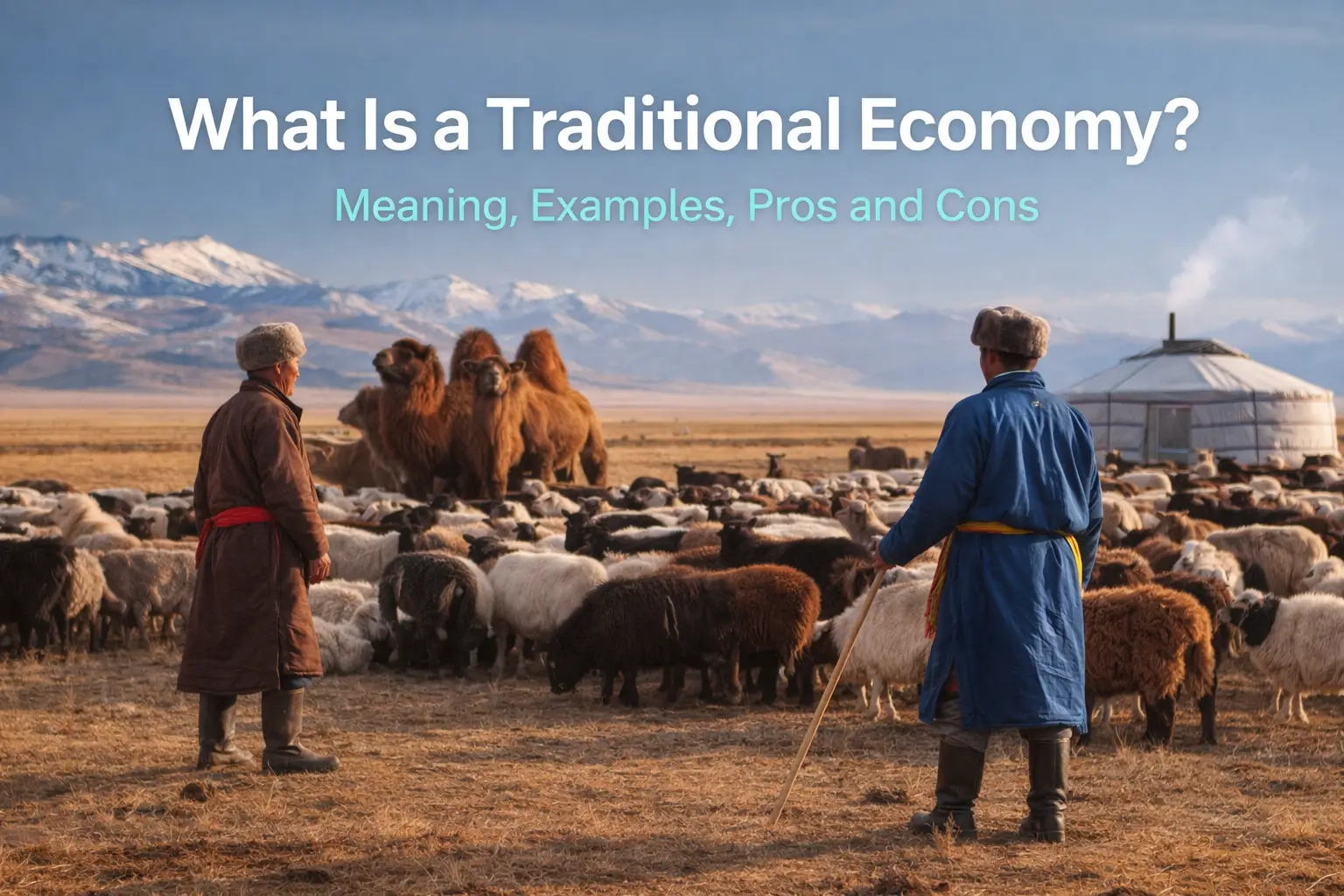
In Mongolia, many families follow a nomadic lifestyle that has existed for over 1,000 years. These families move seasonally across large distances, sometimes 50–200 kilometers per year, to find fresh grazing land for their livestock.
A typical Mongolian herding household may own between 100 and 500 animals, including sheep, goats, horses, and camels. These animals are not just food sources. They are the core of the economy. Milk, meat, wool, and hides are used for daily survival and local trade.
Economic decisions are not based on market trends but on environmental conditions. If a harsh winter (known as a dzud) occurs, temperatures can drop below −30°C, and livestock losses can reach 20–50% in a single season. This shows how vulnerable traditional economies are to nature.
Despite modernization, around 25–30% of Mongolia’s population still relies on this traditional system. Even those connected to cities often maintain ties to rural herding communities.
Traditional Economy vs Modern Economy in Practice
To better understand how traditional economies function, it helps to compare a real example like Mongolia with a highly industrialized economy such as the United States. This contrast shows not just theoretical differences, but how people live, work, and survive in completely different systems.
| Feature | Mongolia (Traditional Economy Elements) | United States (Modern Economy) |
|---|---|---|
| Main Economic Activity | Livestock herding (100–500 animals per family) | Services, technology, finance |
| Work Structure | Family-based, inherited roles | Individual career choice |
| Income Source | Natural products (milk, meat, wool) | Salaries, investments, businesses |
| Technology Use | Basic tools, mobile phones, solar panels | Advanced digital systems, automation |
| Mobility | Seasonal migration (50–200 km/year) | Fixed housing, urban infrastructure |
| Risk Factors | Climate (−30°C winters, livestock loss 20–50%) | Market shifts, inflation, job cycles |
| Productivity | Low, limited by manual labor | High, driven by automation and scale |
| Economic Growth | Minimal (~0–1%) | Moderate to high (2–5% annually) |
This comparison highlights a fundamental difference. In Mongolia’s traditional system, survival depends largely on nature and inherited knowledge. In contrast, modern economies rely on technology, institutions, and global markets to generate growth and stability.
The contrast also shows a trade-off. Traditional systems offer independence and cultural continuity, while modern economies provide higher income, access to services, and long-term scalability.
Traditional Economy Pros and Cons in Real Life
Looking at traditional economy pros and cons becomes much clearer when you apply them to real situations like Mongolia.
- Strong community ties and shared responsibility
- Deep knowledge of nature and environment
- Sustainable use of resources over long periods
- Low reliance on external systems
However, the downsides are significant. Productivity is lower, often 3–6 times less than industrial systems. Economic growth is limited, and opportunities for education and healthcare are often restricted. Environmental risks are also much higher. A single extreme winter can destroy years of economic stability. Unlike modern economies, there are fewer safety nets.
Why Traditional Economies Like Mongolia’s Still Exist?
Traditional economies like Mongolia’s continue to exist not because they are outdated, but because they are well adapted to specific conditions. Mongolia has extremely low population density, with fewer than 3 people per square kilometer, and vast open land where building infrastructure is inefficient. In this environment, nomadic herding, with seasonal movement of 50–200 kilometers per year, remains the most practical economic model.
Climate also plays a major role. Winters can drop below −30°C, and extreme conditions can reduce livestock by 20–50%, making flexibility more important than industrial efficiency. A mobile system allows families to adapt quickly, unlike fixed economic structures.
Cultural identity reinforces this system. Nomadic life is deeply rooted in Mongolian history, and many families choose to continue it as a way of preserving independence and tradition. It is not just an economic choice, but a lifestyle.
At the same time, these economies show a different kind of resilience. They are less dependent on global supply chains, which can be an advantage during global disruptions. While vulnerable to nature, they are often more self-sufficient than highly interconnected modern economies.
Final Insights: Traditional Economy in a Modern World
A traditional economy is a system built on customs, long-established practices, and a close connection to nature. It prioritizes stability, survival, and community over rapid growth or technological advancement. While this creates a predictable and culturally rich way of life, it also limits productivity and the ability to adapt to change.
The example of Mongolia shows how a traditional economic system can still function in today’s world. Families rely on livestock, seasonal migration, and inherited knowledge to sustain themselves, often producing just enough to meet their needs. However, this also means high vulnerability to environmental conditions, where a single harsh winter can reduce livestock by 20–50% and directly impact survival.
In contrast, a modern economy like that of the United States operates on a completely different foundation. Income is generated through salaries, businesses, and digital systems, while risks are tied more to market fluctuations than to nature. Productivity is significantly higher, and access to healthcare, education, and infrastructure improves overall quality of life.
Ultimately, the comparison highlights a clear trade-off. Traditional economies offer independence, cultural continuity, and a deep connection to the environment, while modern economies provide higher income, stability through institutions, and long-term growth. Understanding this difference is key to seeing not just how economies function, but how they shape the way people live.